Find the shutoff before an emergency and label it so someone else can find it too. This guide covers an accessible household water-supply valve. It does not cover gas valves, a utility’s street valve, well-pump controls or shutting down a fire-sprinkler system.
Identify the domestic water shutoff. Close a lever ball valve a quarter turn to cross the pipe, or turn a wheel valve gently clockwise. Check a faucet to confirm the supply stops.
Go straight to the stepsBefore you begin
Do not enter floodwater that may contact energized electrical equipment. If access is unsafe, stay clear and call for help. Do not force a seized or corroded valve. In a home with fire sprinklers, identify the domestic branch before a planned shutoff so the sprinkler supply stays available.
What you’ll need
- Flashlight
- Clear, dry access to the valve
- A label and marker
- Your plumber’s and water utility’s contact details
Tools & supplies for this project
Affiliate disclosure: We may earn a commission when you buy through these Lowe’s links. How our links work.
Use what you already own. If you need supplies, compare these options with the requirements above and choose only the items your project needs.
Check Lowe’s for current price, availability and specifications.
Let’s do this
Step by step
- 01
Locate the incoming water line
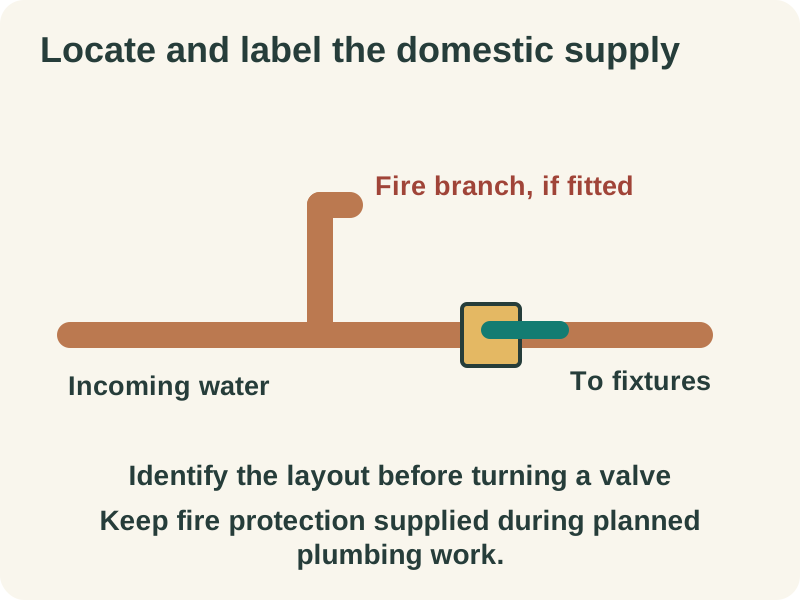
Look near where the service pipe enters the basement or foundation, then in the utility area. In homes without a basement it may be near the water heater or a cabinet, but layouts vary. Use property records or a plumber if you cannot identify it; do not assume the nearest handle is the water main.
- 02
Confirm what the valve supplies
Trace the domestic water line and read existing labels. A valve serving only a water heater, irrigation branch or one fixture will not isolate the whole household supply. Where a fire-sprinkler branch exists, get the correct domestic shutoff identified rather than closing valves experimentally.
Open full-size image - 03
Recognize the handle type
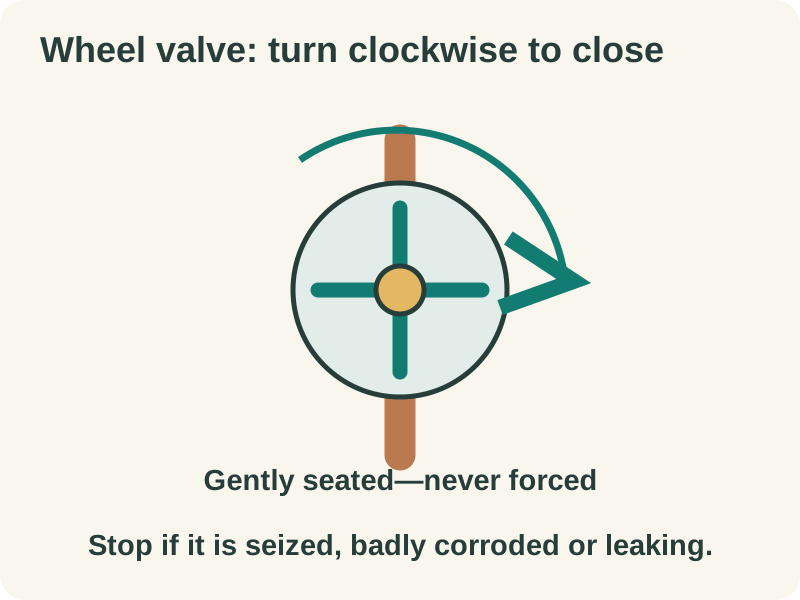
A lever on an ordinary ball valve has a quarter-turn travel. A round wheel normally takes several turns. Check the valve markings and condition before starting; the handle shape does not establish which branch it controls.
Open full-size image - 04
Close the valve gently
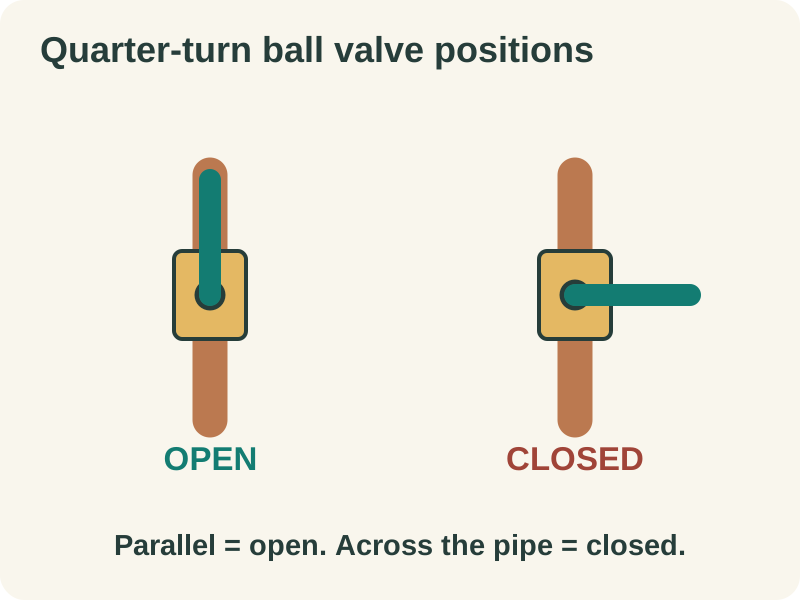
On a standard quarter-turn ball valve, move the lever to its closed stop, perpendicular to the pipe. On an ordinary wheel-handled shutoff, turn clockwise until gently seated. Do not force either beyond its stop or use an extension on the handle. A stiff or leaking valve needs service.
Open full-size image - 05
Check that the flow stops
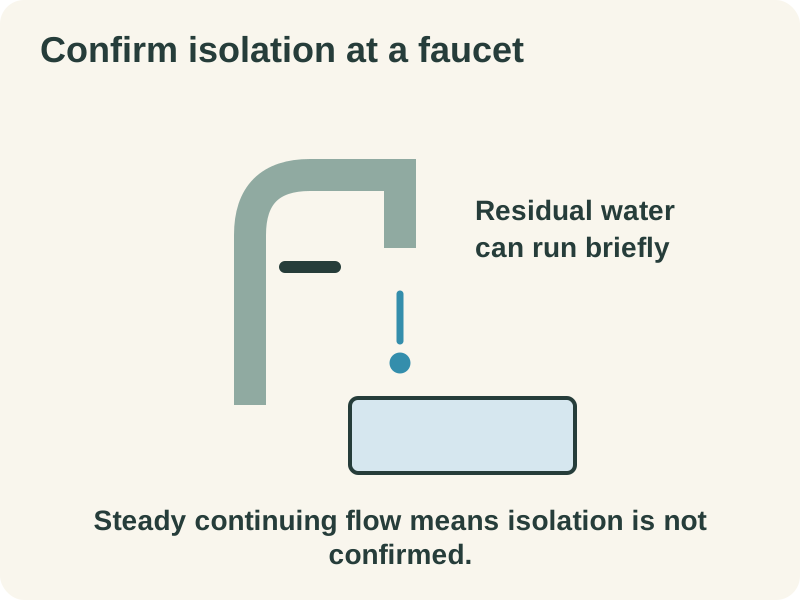
Open a cold faucet and allow the trapped pressure and residual water to fall away. Continuing steady flow can mean the wrong valve or a valve that does not seal; call a plumber. Closing the main does not instantly empty every pipe. Avoid draining tanks or heating systems as part of this simple check.
Open full-size image - 06
Keep the supply off until ready
For an active leak, leave the supply closed while the repair is arranged. Tell everyone in the home. If the outage will be extended, or the work involves draining water heaters or boilers, have the appliance requirements handled separately by a qualified person.
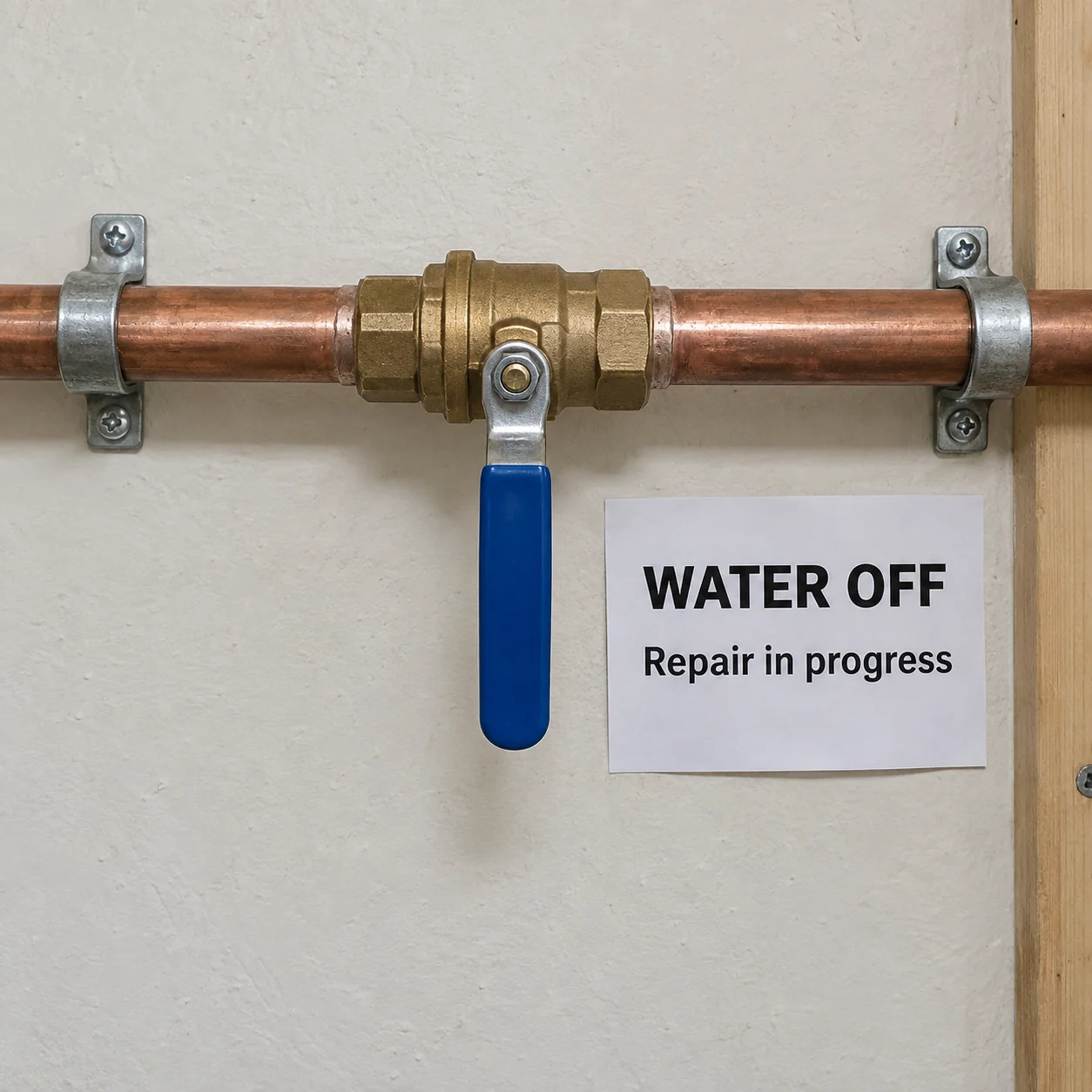
Tell everyone the water is off and leave a clear notice while the repair is arranged.Open full-size image - 07
Reopen carefully after the repair
Confirm the repair is complete and the system is ready to refill. Open the main slowly, following any plumber or utility instructions. Let air escape at a suitable faucet, then check the repaired area and valve for leakage. Do not leave the property until flow has settled and the connections stay dry.
Optional supplies on Amazon
Affiliate disclosure: As an Amazon Associate I earn from qualifying purchases. How our links work.
Use what you already have. These links open Amazon search results so you can compare suitable supplies; they are not individual product reviews.
Make a household shutoff note
Write a plain location such as ‘basement front wall, beside the laundry sink’ and attach a clear tag to the correct valve without obstructing it. Photograph the valve and its surroundings. Keep the route free of storage boxes and show another household member where it is.
A street valve is a separate matter
Meter boxes and curb stops belong to a different procedure, with rules set by the local utility. If your indoor valve does not work, contact that utility or a plumber. Do not dig up, force or operate unfamiliar street hardware based on a general household guide.
A quick final check
- Domestic water valve correctly identified and accessible.
- Valve closed without forcing it.
- Supply stop confirmed at a faucet.
- Repair complete and leak check passed before normal use resumes.
Common questions & sticking points
Is the main water valve open when its lever follows the pipe?
For a standard lever-operated ball valve, parallel normally means open and perpendicular means closed. Check its markings and identify the valve first; this visual rule does not identify which system the pipe serves.
Why does some water still come out after I close the main?
The plumbing still contains water and pressure. Brief residual flow can be normal, while steady continuing flow needs investigation. Do not disconnect piping until isolation is confirmed.
Sources & further reading Optional
References used to check this guide. Follow your product’s own safety instructions where its design differs.
- WSSC Water: Domestic valves, fire branches, closing and reopening
- Kentucky American Water: Finding, testing and labeling a shutoff
- Seattle Emergency Management: Prepare and identify household utilities
- Seattle Public Utilities: Water shutoff assistance and local procedures
- Seattle Public Utilities: Leaking or burst-pipe response