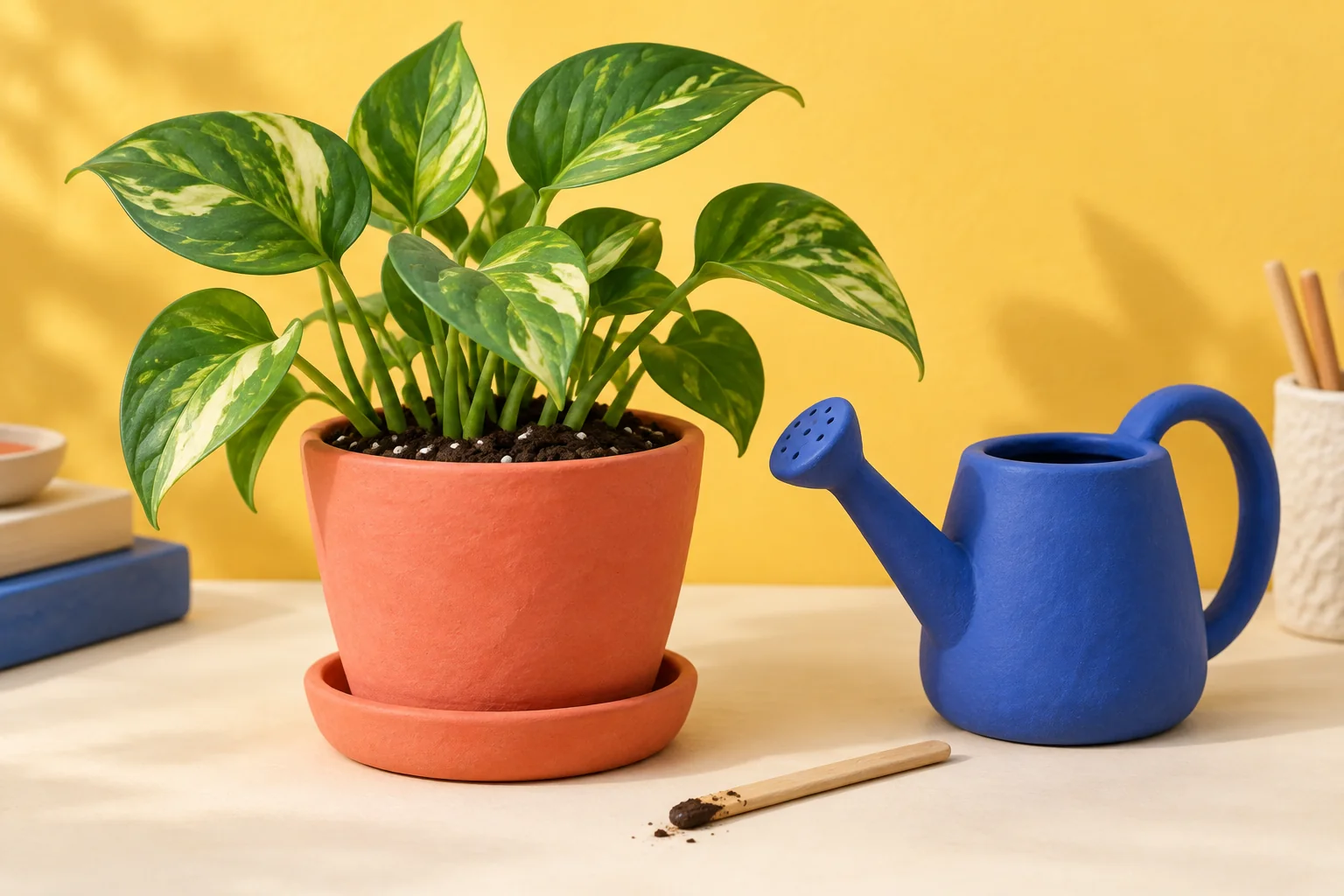
There is no single weekly schedule that suits every houseplant. A small pot near a bright window can dry very differently from a large pot in a cool corner. Use a calendar to remind you to check the plants, then let their needs determine whether you actually water.
Identify the plant’s moisture needs, check the potting mix, water when needed, and let excess water drain completely. Do not leave the pot standing in a full saucer.
Go straight to the stepsBefore you begin
Cacti, succulents, many foliage plants, and moisture-loving plants have different needs. This is a checking routine, not one universal dryness threshold.
What you’ll need
- The plant’s identity or care label
- A pot with drainage
- Water appropriate for the plant
- A sink, tray, or saucer
Let’s do this
Step by step
- 01
Learn what the plant prefers
Read its care label or a reliable species guide. Find out whether it should dry between waterings or remain more evenly moist.
- 02
Check the mix and pot
Check the growing mix at the depth recommended for that plant, not only the dry-looking surface. Lift a manageable pot to learn its weight when recently watered and when ready again. If the mix is still wet, do not add water just because leaves droop.
- 03
Water the growing medium
When watering is needed, apply water to the mix so the root area is moistened. For ordinary potted foliage plants, allow excess to pass through the drainage holes.
- 04
Drain and empty
Allow drainage to finish, then lift the nursery pot out of any decorative cover and empty the collected water. Empty the saucer too. Put the plant back only when its base will not sit in standing water; an attractive outer pot can hide a full reservoir.
- 05
Check again before the next watering
Light, temperature, pot size, and growth change water use. Adjust the interval based on what you observe rather than repeating an amount forever.
Optional supplies on Amazon
Affiliate disclosure: As an Amazon Associate I earn from qualifying purchases. How our links work.
Use what you already have. These links open Amazon search results so you can compare suitable supplies; they are not individual product reviews.
Turn a reminder into a check, not a command
A reminder reading “check plants” is more useful than one reading “water all plants.” Walk through the collection and decide separately for each pot. One may need water while the next is still damp.
For a week or two, note the check date, whether the mix is wet or approaching the plant’s watering point, and whether you actually watered. Compare the same pot in the same location. This creates a useful routine without treating every check as permission to add water.
Respond to a symptom with a check
Drooping or yellowing leaves can have more than one cause. Before adding water, check whether the pot is already wet. Also look at the plant’s location and recent changes. Moving it, feeding it, and watering it heavily on the same day makes the result harder to interpret.
A quick final check
- The watering decision fits the plant’s needs.
- The pot can drain.
- No water remains trapped around the roots.
Common questions & sticking points
Should I water every Sunday?
Use Sunday as a checking reminder if useful. Water only the plants that need it.
Can all houseplants use the same water?
Some plants are sensitive to water quality. Follow species guidance; RHS also advises avoiding water from domestic salt-based softeners.
Sources & further reading Optional
References used to check this guide. Follow your product’s own safety instructions where its design differs.
Last source check: September 22, 2026