Avoid adding oils, waxes, or commercial leather dressings in an attempt to restore it. Deteriorating leather may need professional assessment, and surface treatments can cause further problems. Limit handling and place the volume in a suitable protective enclosure to contain loose material and protect adjacent books. Keep detached pieces with the book, and ask a conservator about support or repair if you need to use it.
Use outfits when each day has a clear activity and you want to pull out one ready-made set. Use categories when you will mix shirts and trousers throughout the trip. For a shared family suitcase, separate people's belongings first. Choose the system you will understand while unpacking in a small room; a beautifully filled cube is less useful if you must empty three others to find your socks.
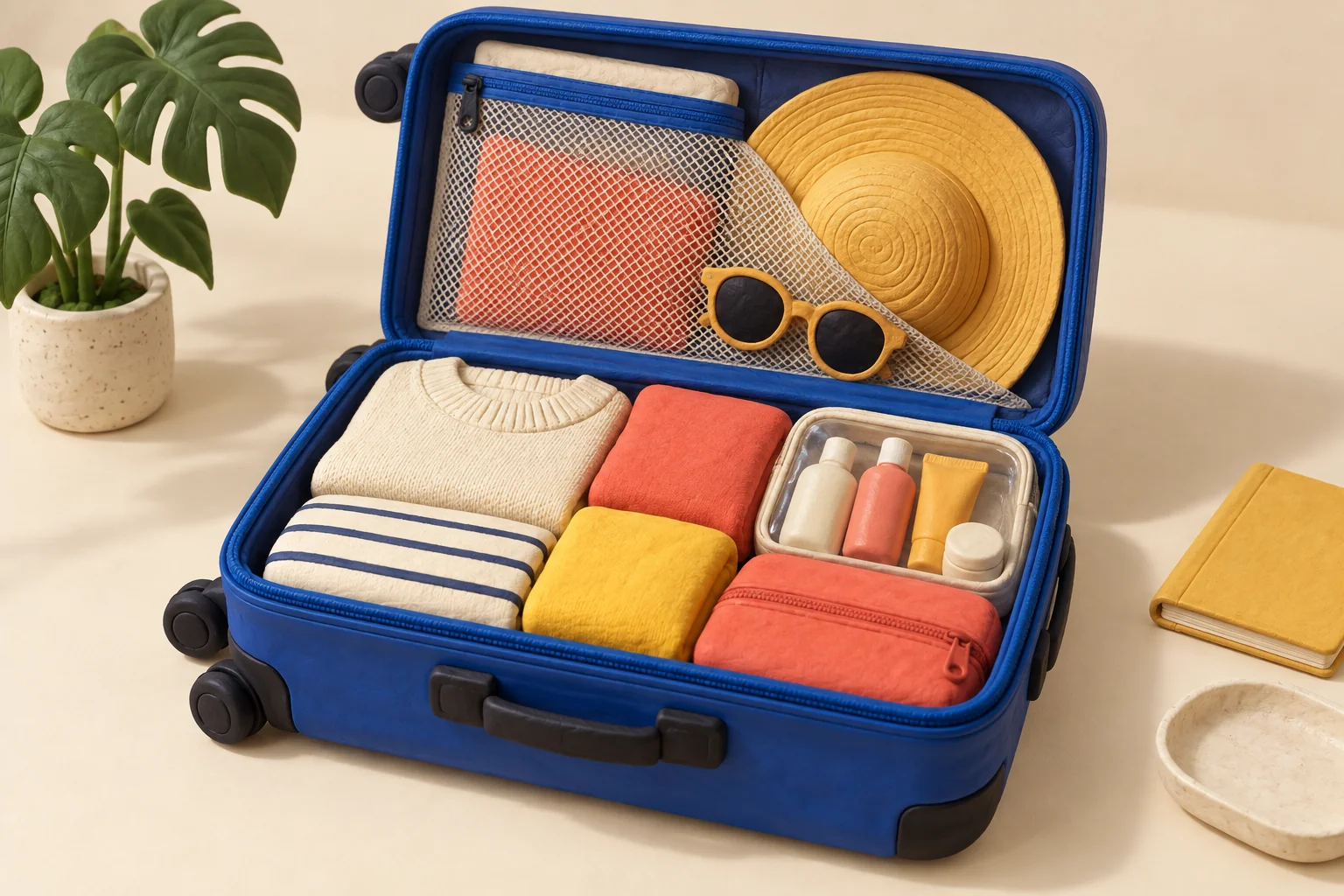
Do not rely on a mesh clothing cube to contain liquid. Use a pouch specifically designed for wet items or toiletries, and check its construction and closure. A cube can organize bottles without being leakproof. Keep clothing cubes for dry contents and plan a separate place for laundry. This preserves the organization you created instead of letting one leaking bottle wet several carefully packed outfits.
On a cube with separate opening and compression zippers, open the expansion section, pack the clothing and close the main compartment first. Then close the compression zipper to reduce the cube's depth. Keep loose fabric clear of the zipper instead of forcing an overfilled cube shut. Compression reduces the space soft clothing occupies; the contents still weigh the same when you put the cube in your suitcase.
Use the bag's overall exterior dimensions, including protruding wheels and handles where the airline requires them. The packing compartment's advertised size can be smaller than the suitcase's full height. Measure the packed bag in all three directions and compare it with your carrier's current allowance. A label such as twenty-two-inch carry-on does not establish that every airline will accept that particular bag.
Only if the expanded, packed bag still meets your airline's allowance. Expansion changes depth, and an overfilled front pocket can add more even when the expansion zipper is closed. Measure after packing and check the requirements for the actual trip. An expansion feature is useful capacity, but it is not a promise of cabin acceptance; you may need to remove items or check the bag.
A clamshell commonly divides its packing space between two halves that open flat, so both halves need room while you unpack. A single-lid suitcase usually offers one deeper compartment and can be easier to use on a narrow luggage stand. Consider the shape of your belongings and the space where you will open the case. Check the actual layout rather than judging only by hard or soft construction.
A hard shell can shed water, but that does not make the complete suitcase waterproof. Water may enter through zippers and other openings, and construction differs between models. Protect items that must stay dry inside suitable inner bags and avoid leaving luggage exposed unnecessarily. Compare the maker's actual water-resistance claim rather than assuming a rigid surface provides the same protection as a sealed waterproof container.
No. A plug adapter connects compatible plug and socket shapes; it does not automatically convert the supply voltage. Read the appliance or power supply's input label and compare it with your destination's supply. A charger marked for a suitable wide input range may need only the correct adapter, while a single-voltage appliance may be unsuitable. Follow the appliance maker's instructions rather than assuming that a fitting plug proves compatibility.
Choose an adapter explicitly compatible with the appliance's grounded plug and the destination socket. A two-pole adapter designed for ungrounded devices does not provide the protective earth connection a grounded appliance requires. Do not force a plug into a similar-looking opening or modify it to fit. Check both the plug type and the adapter's electrical rating before packing it for the trip.
Under these standard UNO rules, the affected player draws two cards and loses that turn. They cannot avoid the penalty by adding another Draw Two. The instruction allowing a Draw Two on another Draw Two applies when a player has a normal turn, not while serving a draw penalty. Stacking is a house rule unless your particular UNO edition explicitly includes it; agree which rules you are using before play.
Optional tools & supplies
Affiliate disclosure: We may earn a commission when you buy through these links. As an Amazon Associate I earn from qualifying purchases. How our links work.
You may play it only when you have no card matching the current discard color. A matching number or action symbol in another color does not stop you. If challenged, show your hand to the challenger: an illegal play makes you draw four instead; a correct play makes the challenger draw six. Check your edition's rules, since specialized UNO versions may handle draw cards differently.
You may change which hand you use, but only one hand may touch the tower at a time. Holding the tower steady with one hand while pulling a block with the other is therefore not allowed. Keep the unused hand clear before switching. This makes careful testing and controlled movement part of the game, even when a two-handed grip would feel easier.
The official rules end the turn when the next player touches the tower or after ten seconds, whichever happens first. Simply letting go of your placed block does not always finish your responsibility immediately. Give the tower a moment to settle and keep the timing consistent for everyone. If it falls during your turn, that determines the losing player under the classic rules.
Yes. On your third roll you may reroll some or all of the dice, including ones you kept earlier. You also may stop after the first or second roll and score immediately; three rolls is the maximum, not a requirement. Decide which remaining score box you are pursuing before rerolling, because every turn must end with an entry on your scorecard.
You still must fill one empty box for that turn. If the dice cannot score there, enter zero; you cannot skip recording a turn or reuse a filled box. Check all your available choices first, since an upper-section box can score even one matching die and Chance accepts any roll. Once you choose a box, treat that decision as spent for the rest of the game.
A word may follow touching cubes horizontally, vertically or diagonally, changing direction along the way. However, you cannot use the same physical cube twice within that word. Two different cubes showing the same letter are fine if the route connects legally. Trace the path when checking a disputed word: having all the required letters somewhere on the grid does not by itself make the word valid.
Nobody scores that shared word under the standard rules. Cross it off every matching list before adding points for the remaining unique words. Finding the same spelling in another part of the grid or assigning it a different meaning does not earn extra credit either. Compare everyone's lists first, so you do not mistake a long but widely spotted word for a high-scoring exclusive find.
No. Announce the letter when you place the blank, and it remains that letter for the rest of the game. Its own value stays zero, even on a letter-premium square or when used in a later word. A word premium can still multiply the total of a newly formed word containing it. Remember the declared letter when extending words around the blank.
No. A premium square applies only on the turn a tile is first placed on it. When you later extend or cross that word, previously placed letters contribute their normal tile values without reactivating their old premiums. Apply any premiums under the new tiles for the current play instead. Distinguishing the newly placed tiles from existing ones prevents repeated bonuses when several words cross.
In Bicycle's standard version, you must already hold at least one card of the rank you request. Ask a specific player for that rank, and they must give you all their matching cards. If they have none, draw from the stock. This keeps a request connected to a book you are building rather than allowing unrestricted guesses about every rank in the deck.
No. The goal is to collect the most four-card books, not simply empty your hand. In the cited rules, a player with no cards may draw from the stock on their turn and continue asking for that rank. If the stock is empty, that player is out. Finish when all thirteen books have been collected, then compare book totals to decide the winner.
Choose a suit. In Bicycle's rules, every eight is wild and can be played on your turn regardless of the previous card. The following player must play a card of your named suit or another eight. You do not call a number for them to match. State the suit aloud when you place the eight so everyone knows which requirement now applies.
Under Bicycle's published version, you pass if you cannot play and the stock is exhausted. Before it runs out, you draw until you can make a play or there are no cards left. Some households use different drawing or reshuffling rules, so agree on the version before starting. Do not silently switch to a one-card draw rule simply because that is familiar from another game.